
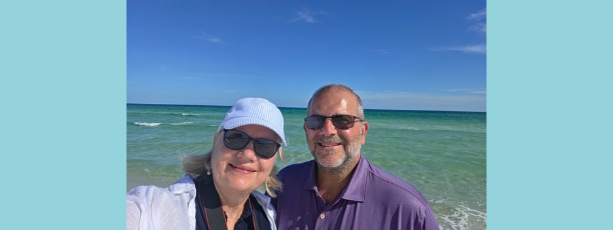
Mark Arata: The Big Easy’s Ticketing Wise Guy
If INTIX ever needed a court jester, Mark Arata , Box Office Manager at Caesars Superdome/Smoothie King Center/Champions Square, could be the leading candidate. Thirty-eight years in ticketing has taken him through a succession of arenas and more than his share of opening nights. For the past 25 years, he has been part of the New Orleans sports and entertainment scene, where the work is demanding, the hours are long and no two events are quite the same. And if there is one thing he has learned, he says, “Life’s too short to be grumpy.” Ask Mark who he admires most and you won’t get the name of a celebrity. You’ll get his grandfather, a World War II veteran who lost both legs and refused to be slowed down. “He was self-taught, fixed anything, moved around, took us to ballgames, did everything,” Mark says. “I’m not really starstruck by people too often, but he was my hero.” Mark’s own priorities are clear. In a colleague, he values someone “reliable, dependable and funny.” That matters in a job like his. “The hours are awfully long here,” he says. “You have to have a good time doing it.” In a leader, he looks for “compassion, empathy and somebody who’s willing to get their hands dirty.” The best bosses he has worked for knew the job inside and out, were willing to jump in and help fix problems, let people learn from their mistakes and understood that employees have lives outside work. “Your kids are sick, take the day off,” he says. “If your car’s broken, don’t worry about it. Get your work done. I don't like micromanagers. I don’t think I am one, and I’ve never really worked for any of them. The ones I did have that were micromanagers, I didn’t work for them for very long. Friendship runs on similar rules. Mark’s closest friends are mostly people he has known since college, for more than 40 years now. “[I value] loyalty and a sense of humor,” he says. “I guess our values are the same in the irreverence of it all.” And what about the greatest love of his life? “I better say my wife, or I’m in a lot of trouble!” he jokes. Ingrida and Mark Mark and his wife, Ingrida, met in Tampa, where she was an event services manager at the convention center and he worked at the arena. The two kept crossing paths at mutual events. “One thing led to another, she agreed to go on a date with me and that was her demise,” he says. “I’m fortunate enough to have tricked [her] into marrying me about 30 years ago.” The couple has two grown children: John, 26, a pilot based in Chicago, and Lauren, 22, who works in finance in Charlotte. Together with sports, his wife and kids are what bring him the most joy. John and Lauren Mark credits Ingrida with keeping the household steady through a career of odd hours. “She’s been great, putting up with all the jobs, all the hours, all the different things,” he says. Lauren once came to an INTIX conference hoping to follow in her father’s footsteps. He steered her elsewhere. “She really thought she would walk into what I’m doing,” he recalls. “I was like, ‘No, there’s 15 years of suffering before you get to that part!’ So, we steered her into a professional career where I don’t have to pay her rent anymore, which is very helpful.” Music runs in the family, though it skipped Mark. John is a gifted pianist. However, Mark does admit he took up the drums as a teenager for reasons that had little to do with art. “I played the drums in high school so I could hit things loudly and annoy people, but there was no real ability whatsoever,” he says. Mark’s most treasured possession is a 1967 Austin-Healey that belonged to his father, who owned one while stationed in Europe with the Air Force. The car has been in the family for nearly 50 years. “I inherited it when he passed away … It’s the only real thing I have left from my dad,” he says. It is one of three in his garage, alongside a 1965 Volvo 1800 and a 1994 300ZX. The latter is the car that actually gets driven. Yet Mark’s collection comes with a cost. “I have three antique cars, and they’re always in the shop,” he says. “I wish I could fix my own cars so I didn’t have to spend all this money every time they break … The ZX300 is dark green [with] T-tops. It’s a fun car. I haven’t gotten any speeding tickets in it, which is nice.” Then there is golf, which Mark claims to play “very badly.” For about 35 years, he has taken an annual trip to England or Scotland with a college friend who is deeply involved in golf course architecture. The two sit on Golfweek panels that rate courses around the world, which brings perks. His favorites are North Berwick in Scotland, “a very quirky golf course, right on the water, a little bit away from St. Andrews,” and Sunningdale in England, which he calls “probably the nicest 36-hole course in the world.” The trips have another appeal. “I wish they had never invented a cell phone because you just can’t get away from the damn job. That’s the blessing and the curse. It lets you out of the office, but they get to you 24/7,” he says. “Part of the reason I like going overseas is that my phone doesn't work quite as well over there, so they can’t quite get to you as much.” When Mark first got into ticketing, he was an aspiring professional baseball umpire. “I went to umpire school. I made it to the major leagues for a day,” he recalls. “I could have gone that path if I had dropped out of school and gone that direction when I was younger. But I never would have met my wife. Who knows what would have happened. Everything happens for a reason.” Mark behind the plate Mark still umpires Division I college games in Louisiana and he watches a lot of sports. He admits his loyalties cause him some irritation. “My teams are cursed,” he says of the Mets, Jets and Rangers. “One of them will win a title again in my lifetime, but I wouldn't bet on it,” he says. Mark used to root for the Knicks, but a job with the Miami Heat and a friend who is the team’s general manager changed that. “I’m kind of obligated to root for them,” he says. His favorite artists, true to his New Jersey roots, are Billy Joel and Bruce Springsteen. His favorite Billy Joel song is “Only the Good Die Young.” “I like the irreverence of it, and I like the wordplay of the whole song. I always thought that was really great,” he says. So, what’s next? Well, Mark and his wife are still deciding where they’ll land one day, and Chicago, where John lives, is high on the list. The Windy City has a catch, as he learned at an INTIX conference there. “I really enjoy Chicago in the summertime,” he says. “I don’t think I could live there in the winter.” He credits the 2014 INTIX Chicago conference, where he won a Ticket Star award and got frostbite on the same trip. “It was basically about 50 yards from the hotel to the Walgreens across the street, and I got frostbite walking those 50 yards and back,” he says. “That was the year they decided to do the gala on a riverboat on a frozen river.” INTIX peers after a conference dinner get-together. L-R (back row): Bob Beatty, Karen Sullivan, Mark Arata, Tracy Noll, Danny Frank, Russ Stanley, Dan DeMato and Jeff Hecker. Front row: Veronica Lawlor, Shannon Arney and Curtis Howells. Mark grew up going to Madison Square Garden, a venue he calls “the granddaddy of them all.” He worked in Miami, Tampa, Houston and New Orleans, and he notes that most of the buildings he worked in have since been torn down. “Most of the buildings I worked at are no longer there. One's a church — the Summit in Houston. The other ones are gone. I think I have one more to go before I become an ace of killing buildings,” he says. Mark’s career began at Miami Arena, which opened in 1988, in a box office run by Jennifer Keller, Sheri Voigt and Jill Shepard. He still considers them his first and best mentors. “That first box office in Miami with Jennifer, Sheri and Jill was pretty amazing,” he says. Mark worked at the Sun Dome in Tampa and the Summit in Houston, then spent two years touring with Live Nation, working with Louis Messina on tours for George Strait, Ozzfest and the Chicks. “Louis is one of the greatest of all time,” he says. He has been in New Orleans since May 2001. It wasn’t love at first sight. Mark and his then-fiancée visited the French Quarter in 1995 for what was supposed to be a three-night weekend. “We couldn’t understand the appeal of this place whatsoever. We were supposed to spend three nights, and we spent one night,” he reminisces. “The only reason we spent that one night is I won $700 at the casino, so we decided to stay. The next day, we walked around and said, ‘This place isn't for us.’” Years later, the Superdome came calling and New Orleans won him over. “I didn’t want the job [at first],” he says. “Turned it down a few times. Finally, they made me an offer I couldn’t refuse, and I took it.” Mark’s wife, with a new baby and a job in Houston, had a different response. “Well, have a great time. I’m not going,” he recalls Ingrida saying. She joined him the following February. Today, some of Mark’s biggest memories are tied to the city he has called home for a quarter century. The Superdome's reopening after Hurricane Katrina stands out. “We honestly didn’t think this place was ever going to come back,” he says. “We thought New Orleans was gone. Then it opened in nine or 10 months and we did a football game. That game was so emotional to everybody in town. U2 and Green Day [played a pre-game concert] … The sound of that, the game, the emotions, the bands, everything,” he says. U2 is also behind another of Mark’s greatest live event memories. The band was the first concert he ever saw, in New York in 1982 or ’83. They also played the Super Bowl halftime show in the Superdome after 9/11. “We were here for the rehearsals the night before, and they did the show. They had the scrim with the names of all the victims of the towers and the planes,” Mark recalls. “The night they did the rehearsal, they scrolled the scrims up. It was emotional, but it wasn't as bad as when they did the show at halftime. They brought them down like the towers. It fell like the towers did, and everybody lost it at that. I think that was one of the more impactful things I ever saw live.” Asked about his greatest achievement, he doesn’t hesitate. “Longevity,” he says. “I’ve been here for 25 years. This is my 38th year in ticketing, and I’m still doing it.” What Mark loves most about the work is also what drives him crazy. “There’s no such thing as a normal day,” he says. “Somebody changes a production, somebody moves the mixer back, somebody throws in a stage thrust they didn’t tell you about, somebody drops a camera in a position it wasn’t supposed to be in. It never stays the same, and that’s part of the allure of the job to me. It’s constantly changing, and you’re constantly being challenged. And then the annoyance of the job is, just once, I'd like to have a normal show. Put it on sale, sell it and leave it alone. Someday that'll happen, but it hasn't happened yet … The two things I can't stand are the way things are and change, so this is a great career to be in.” Outsiders, he points out, tend to misunderstand the work. “You very rarely watch a show anymore, and you very rarely sell a ticket anymore,” he says. “There’s a lot of production work and financial work. It’s ironic that I actually had to bribe my way through accounting when I was in college, and now all I do is accounting.” Looking back, he credits much of his path to luck, and he says patience is the advice he would give his younger self. “I ran myself out of some opportunities because I was impatient when I was younger,” he says. “A million things could have gone a different way if I had been patient. I left the University of South Florida and the Sun Dome a year before they got the football team. I love Tampa. I would have stayed there forever. I tried to get in with the hockey team there. I may have never left Tampa and never gotten this job if I had been patient and waited a little while longer.” Ingrida and Mark However, Mark quickly adds that he has no complaints. “I’ve had a pretty charmed life in terms of careers,” he says. Mark first heard of INTIX, then BOMI, from his Miami mentors, but it wasn't until 2003 that he attended a conference in Denver. “I met a whole bunch of people who were really influential in my life and learned an awful lot,” he says. “David Greenbaum. I cribbed a lot of stuff from him in the day. Jeff Hecker who was with the Jets, Danny Frank, Michael Naughton from the Rams for a long time, Josh Logan from the NCAA, and UCLA’s David Lowenstein helped me out in my first Final Four. I've admired and learned from a bunch of people.” What he gets from INTIX is simple. “People who understand the job,” he says. “The networking is very important. I’ve met a lot of really great people who’ve done remarkable things in this business. For some reason, people consider me in their class from time to time, and I always get a big kick out of that because I don’t think I’ve done anything compared to them. It’s the camaraderie of it all and the ability to pass some knowledge on or gain some knowledge. I think that’s very important in this business.” And the network pays off in practical ways. There is constant communication, and an email chain among colleagues spreads the word fast. “If you’re a bad person on tour, the whole world knows about it right away,” he says. “And if there are things going on that are great, or ideas that people have, we share them. It makes everybody’s life easier, so I really enjoy that part of [being an INTIX member].” Mark has been honored by the community. He won the [VenuesNow / Pollstar] Ticket Star award in 2014 and chaired the 2017 INTIX conference in New Orleans. “I did such a great job that they left me out of it this time, which was great,” he jokes. But the people mean more to him than the titles and accolades. Mark’s most memorable INTIX moment came at that first Denver conference, when a group of strangers sat down and started swapping stories. “Four hours later, we were still there,” he says. Since then, a group of friends from around the industry has turned INTIX dinners into a tradition. “It’s kind of like a family within the INTIX group,” he says. Mark and INTIX peers at another conference dinner get-together. As INTIX heads to New Orleans for the 48 th Annual Conference from January 25-28, 2027, Mark says he has no lead role but is on the conference committee and helping with the venue tours on Monday. “Apparently, court jester would be the role,” he laughs. Mark is hosting an unofficial opening night party on Sunday at Acme Oyster House for anyone who wants to watch the playoff football games. “I learned my lesson last time because it was open bar and wasn’t supposed to be,” he says. “That one came out of my pocket. This time it’ll just be beer and wine.” For first-time visitors, Mark recommends the National WWII Museum, which he calls “awesome,” and the city’s food. “You can’t get a bad meal here, even if you tried,” he says. He adds, “Bourbon Street is great during the day, and then it’s amateur hour at night. Definitely do not walk the streets of New Orleans alone.” What is he most looking forward to in January? “Seeing everybody and having them keep asking me why I haven’t retired yet when I told everybody I was going to retire,” he says. That question has been following him for a while. “I wish I could retire, like, right this second, but I can’t,” he says. The math is part of it. “You can retire at 62, but you don’t have any insurance until you’re 65, so that makes it a little difficult.” For now, he’s still in the building, and he is as self-deprecating as ever. “I have a massive ego, but I try not to let anybody know it,” he says. “But most people know that.” When asked for his three wishes, he used the first on this story. “That nobody ever sees this interview!” he laughed. Sorry, Mark. Wish denied. You May Also Like Jakub Jaroszewicz: From First Ticketing Job to the Hall of Fame The Beautiful Game, a Bowie and a Career in Ticketing: Getting to Know Ben Bray